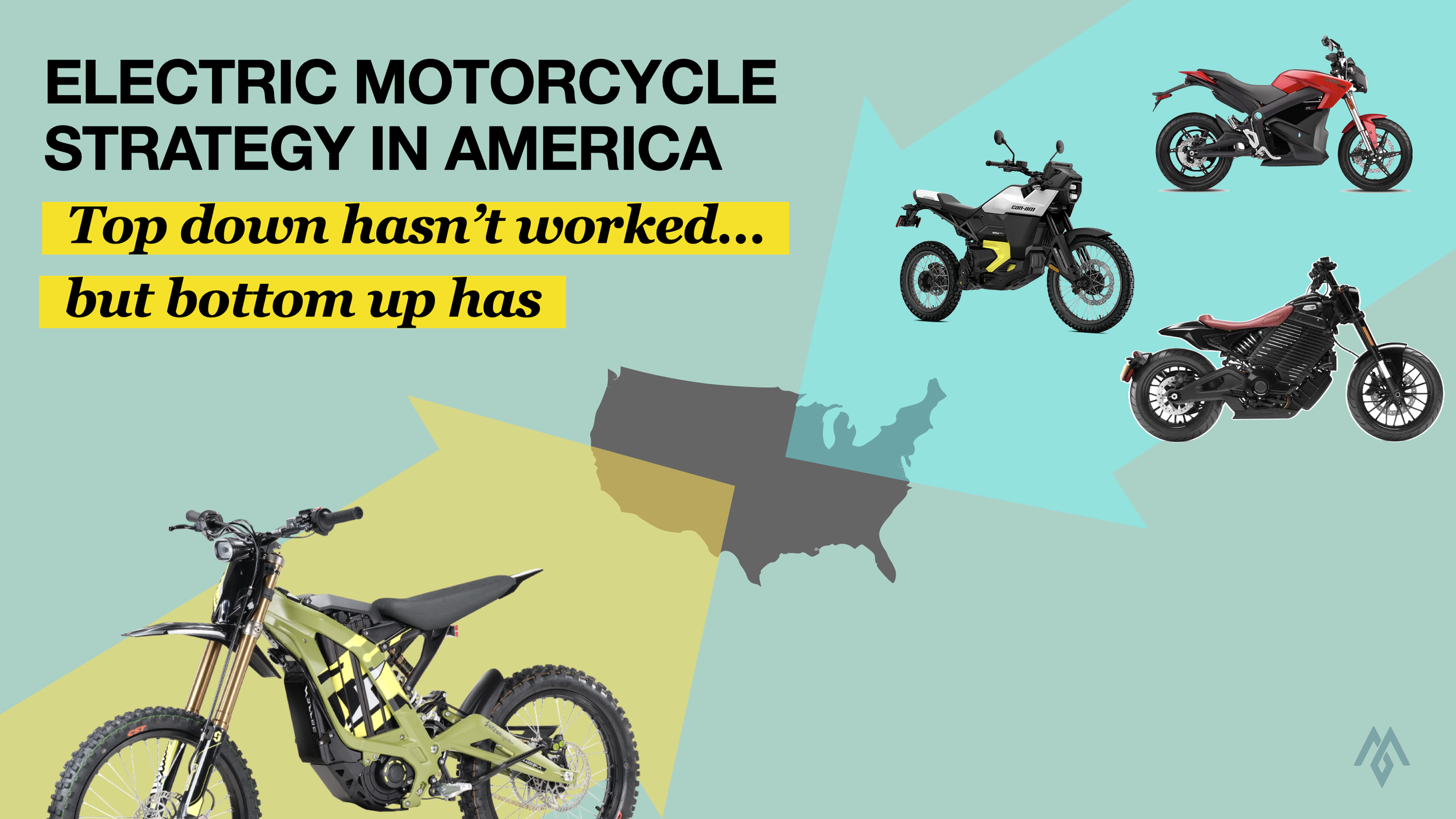
WHERE WESTERN EV MOTORCYCLES WENT WRONG — and where the market actually is
Motorcycle Global Analysis | M. Uhlarik | April 2026
There is a version of the electric motorcycle story that the industry tells itself, quietly, in the margins of investor decks and post-mortems that never quite make it to the press release. It goes something like this: the right idea arrived in the wrong hands. Founders without discipline. Engineers without budget. Boards without nerve. And so the bikes didn't ship, or they shipped wrong, and the money ran out, and the story ended.
That version is comfortable. It assigns blame to individuals, to execution failures, to bad luck. It leaves the underlying thesis intact: the premium electric motorcycle was always a good idea; it just needed better people.
I don't believe that anymore.
Having spent the last several years tracking this market across five continents — from Yadea's factory floors in Wuxi to Surron gatherings in suburban Toronto — I've arrived at a harder conclusion. The Western electric motorcycle industry didn't fail because of bad decisions made by the people in the room. It failed because the entire room was reading from the wrong map. The product category, the price points, the customer profile, the channel strategy — almost every foundational assumption was wrong. And the reason those assumptions held so long without serious challenge was that the macro environment made them feel, for a critical window, like they might be right.
The Decade That Built the Illusion
Between 2015 and 2023, a specific set of conditions made the Western premium EV motorcycle thesis seem not just plausible, but urgent. Tesla had transformed a century-old automotive category into a growth stock narrative. Interest rates across the developed world sat at or near historic lows for the better part of a decade, making capital cheap and patience deep. And the world's most respected names in capital markets — from Goldman to Morgan Stanley to a constellation of boutique cleantech funds — were publishing bullish forecasts for the electrification of personal mobility in every form, at every price point.
In that environment, it was entirely rational to believe that what Tesla had done to the luxury car segment, someone could do to the premium motorcycle segment. The pattern seemed replicable: identify a combustion category; electrify it with superior design and technology; price it at a premium; target urban, affluent, environmentally conscious early adopters; grow rapidly on the back of government incentives and EV enthusiasm.
Brammo believed it. Zero Motorcycles believed it. LiveWire — born from the most storied brand in American motorcycling — believed it, and raised nearly $800 million on the strength of that belief. BRP, a company with genuine industrial heritage and the engineering credibility to back it, believed it enough to spend years and considerable capital producing the Origin and Pulse. These were not naive bets placed by naive people. They were logical extrapolations of the most powerful trend narrative in the history of personal mobility.
The problem was that the narrative was built for cars. And motorcycles, in the Western market, are not cars.
The Misread
The fundamental error was a category confusion that ran so deep it was invisible from inside the industry. In Asia — where the actual electric motorcycle market exists — a two-wheeler is a utility device. It gets you to work, moves your goods, earns your income, reduces your cost of living. The purchasing decision is economic, pragmatic, and often urgent. Price parity with gasoline equivalents matters enormously, and when it arrives, conversion accelerates rapidly. China crossed 55% EV penetration in P2W sales by 2024 not because Chinese consumers love electric vehicles ideologically, but because the economics became undeniable.
In North America and Western Europe, the motorcycle market operates in an almost entirely different register. As we note in the Global Electric Motorcycle Report, in the American and Canadian consumer's psyche, motorcycles exist in the same space as bicycles: recreational vehicles with a limited practical transport dimension. The addressable market for premium gasoline motorcycles — the segment all of these Western EV brands were explicitly trying to electrify — was already contracting before a single electric competitor entered the frame.
You cannot apply a Tesla model to a product category where the buyer doesn't need the product. Tesla succeeded by making a car that was faster, smarter, and increasingly cheaper than its gasoline competition, in a category where almost every adult on earth is a potential customer. The premium electric motorcycle was attempting to make a product faster and smarter than its gasoline competition in a category where the customer base was already ageing, already shrinking, and already deeply attached to the sensory experience — the sound, the vibration, the culture — that electrification specifically eliminates.
LiveWire's result — 653 units sold globally in full-year 2025, against an operating loss of $75 million, from a company backed by the most recognizable brand in motorcycling — is not a management failure. It is a market signal of absolute clarity.
Where The Market Actually Went
While Western brands were building $20,000 electric motorcycles for an imagined customer, the actual electric motorcycle customer was doing something entirely different. They were buying a Surron Light Bee for $4,500.
The numbers are instructive and, if you've been watching the premium segment, quietly devastating. Motorcycle Global research estimates that Surron-type electric off road motorcycles — Surron is a Chinese manufacturer that most Western industry executives would struggle to name accurately in 2019 — were selling between 34,000 and 44,000 units annually by 2024, with approximately half those units landing in the United States. Our private investigation into the US market, which the Motorcycle Industry Council's member-only reporting methodology systematically excludes, identified an additional approximately 44,000 units unaccounted for in official tallies — the overwhelming majority being Surron light off-road models and their direct clones. At the close of 2025, the Surron Light Bee was the best-selling motorcycle among new and young riders in America, with year-over-year growth of 17%.
This is the market. Not a $22,000 adventure touring motorcycle for a 52-year-old with a second garage. A $4,500 electric trail bike for a 24-year-old who has never owned a motorcycle before, sold directly to their door, requiring no dealer visit, no financing application, no license endorsement in many jurisdictions.
The failure of the Western premium EV motorcycle to find its market coincided precisely with the emergence of a new one — and the Western industry, heads down in its PowerPoint decks and its press fleet reviews, largely missed it until the Surron had already taken the hill.
The Cake story captures the period's pathology with painful precision. An extraordinary design sensibility. A genuine commitment to sustainability. Over 100 design awards. A race series. And fewer than 6,000 units delivered over eight years, before bankruptcy in late 2023 after raising $60 million in venture capital. The spending ratio — lavish marketing, under-invested engineering — was the signature condition of the era. Damon Motors, from Vancouver, raised over $70 million promising a 320 km/h electric superbike with shape-shifting ergonomics and 360-degree radar ADAS, gathered 3,000 pre-orders, and delivered zero paying customer units through the close of 2025.
These are not cautionary tales about bad actors, though some bad actors were present. They are cautionary tales about an industry that believed a macro narrative more than it believed the market data in front of it.
A Forward-Looking Segment Map
The electric motorcycle market exists. It is large, growing, and structurally sound. It is simply not where the Western industry was looking.
The segment with the clearest runway in Western markets is the one Surron accidentally invented and that Zero Motorcycles is now intelligently pursuing with its XE and XB models: the lightweight, off-road or lightly road-legal electric motorcycle, priced below $7,000, sold direct-to-consumer, targeting new and younger riders. This segment has a genuine new-rider acquisition function that the premium segment never achieved. It is growing at over 17% annually in the US with essentially zero marketing spend by the leading brands.
The mid-power urban segment — analogous to the 125cc-400cc gasoline commuter, positioned between $7,000 and $13,000 — has legitimate potential in European cities where low-emission zones are real and where motorcycles serve genuine daily transport functions. BMW's CE 04, despite its limitations, has demonstrated that design-led premium urban e-scooters can find buyers. Honda's WN-7 platform, priced aggressively and targeted as a genuine mid-premium naked roadster rival, may finally bring the Japanese OEM scale to bear on a segment that has needed it.
The high-power premium segment — above $15,000, targeting enthusiast sport, touring, and adventure riders — faces structural headwinds that are not solvable by better execution alone. Battery energy density improvements at approximately 10% per year are real and will eventually close the range and performance gap with gasoline equivalents. But that gap remains significant today, and the addressable market is small, ageing, and deeply brand-loyal to Ducati, BMW, and KTM in ways that are not easily disrupted. Stark Future's success in the electric enduro niche — $131 million in revenue and approximately 8,000 deliveries at the close of 2025, backed by Royal Enfield's strategic investment — demonstrates that focused, technically excellent execution in a well-defined niche can generate real returns. It is not, however, a template that scales easily.
The battery swapping ecosystem — Gogoro's model, expanding through Hero MotoCorp in India and Gojek-Gogoro in Indonesia — is the structural innovation most likely to unlock mass-market conversion in cost-sensitive markets. At $108 per kWh at pack level in 2025 and continuing to decline, and with 12,300 stations already deployed, the BaaS model resolves the range anxiety and upfront cost objections that have slowed adoption more effectively than any single vehicle breakthrough.
The Honest Reckoning
The cheap money era is over. The EV auto boom has matured into something more complicated. The prestige forecasts have been quietly revised. And the Western electric motorcycle industry — those parts of it that remain — is navigating a market that looks almost nothing like the one it raised capital against.
That is not a scandal. It is the normal cost of being early to a real transition with an imperfect theory of the market. The transition is still real. Electric mobility will continue to take share from combustion two-wheelers at a rate that, since 2009, has gone from 0.3% to over 14% of global P2W sales, and shows every sign of continuing.
The brands that will matter in the next decade will be the ones that find the customers where they actually are — younger, more price-sensitive, more direct-channel oriented, and far more numerous in Bangkok, Bengaluru, and Bogotá than in Berlin or Boston — rather than the ones they imagined when the money was easy and the narrative was clean.
The market did not fail the Western electric motorcycle industry. The industry failed to find the market.
_____________________________________________________________________________________________________
© Motorcycle Global 2026. All data sourced from Motorcycle Global Global Electric Motorcycle Report 2026 unless otherwise indicated. This analysis does not constitute investment advice.